BlindFaith
Specialist Contributor
- My Satellite Setup
- -
120cm Echostar and 70cm (2nd location)
TBS 5925
- My Location
- 52,0°N, 4,3°E and 52,5°N, 13,4°E
I would point the antenna at the wanted spot ;)


Well if they are fixed antennas that would mean orientating the whole vehicle differently during the testing phase to how it would be in the final location. And also that theory does not answer the question as to how Solly and Satesco are receiving 12422 when you yourself believe this is being edited on the UK spot beam. If the spot beam were really pointing at the UK Satesco would be 2.7º off axis, and Solly quite a bit more.I would point the antenna at the wanted spot ;)

You are just assuming those are the only beams on the satellite. It wouldn't be the first time there were more beams on the satellite than on the literature. Astra 1KR is a good example. No one knew there was a spot beam on there until it was switched on. Also how do you explain Solly receiving 12422 but not 10754, while my situation is vice versa (although I can see 12422 to some degree).Looking at the original footprint maps again I cant believe anyone in Europe is getting the tested African beam even if it is some way off its intended position.......in Europe we must be looking at only 2 beams surely....
..too many uncertainties. I was just referring to @Llew's posting. The distances between the other observers are quite substantial...Well if they are fixed antennas that would mean orientating the whole vehicle differently during the testing phase to how it would be in the final location. And also that theory does not answer the question as to how Solly and Satesco are receiving 12422 when you yourself believe this is being edited on the UK spot beam. If the spot beam were really pointing at the UK Satesco would be 2.7º off axis, and Solly quite a bit more.
You are just assuming those are the only beams on the satellite. It wouldn't be the first time there were more beams on the satellite than on the literature. Astra 1KR is a good example. No one knew there was a spot beam on there until it was switched on. Also how do you explain Solly receiving 12422 but not 10754, while my situation is vice versa (although I can see 12422 to some degree).
I don't know about Ka band tests, and anyway these could be done at 28E as there is no conflicting transmission from that position. I'm talking about the possibility of additional Ku band beams that do not currently appear on SES literature.Im no expert but isnt the Ka band also being tested??
I don't know about Ka band tests, and anyway these could be done at 28E as there is no conflicting transmission from that position. I'm talking about the possibility of additional Ku band beams that do not currently appear on SES literature.

@Llew, could you check 12300V? There's a very weak signal like the one in the low band at 11357H
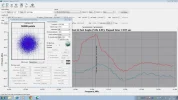
Llew, last night you were getting -47dBm on 12422H. How does that compare with the signal level you receive from Astra 1N (on the same dish)?
Llew, last night you were getting -47dBm on 12422H. How does that compare with the signal level you receive from Astra 1N (on the same dish)?
<snip>
I’m no expert, but I’m having a really hard time understanding the notion that because a satellite is testing at a position 15 degrees east of its intended position, its footprint would be shifted by the same amount.
Would there be any reason to do this deliberately?
<snip>
