Astra 2E: Transit to 28.2E

Status
Not open for further replies.
I've done a bit of totting up here in respect of what SES could move to what and provide backup with (on arrival of 2E to the 28E fleet):

Currently utilisation breaks down to:

Astra 2A - 19TP's
Astra 2F - 19 TP's
Astra 1N - 29 TP's (plus three or four extra data TP's)

If 2E took on 2A's broadcast traffic then would tot up a total of 35 TP's (plus potentially the data TP's)
If 2F takes on 1N's 13 PE TP's then would total up to 32TP's total

This would mean 2E DR backup being 2A and 2D covering 19+16 TP's total, 2F's traffic could be covered by 13 TP's from 2E and 19TP's from 2A, assuming 2A can cover 2F's current higher spectrum TP's from 12.5GHz upwards?

They might just leave 2A going and migrate all 19TP's on here to 2G once she arrives but given 2A's age and utilising it for DR purposes at 23.5E they may offload her? If they move 2C back to 28.2E earlier then this can cover the C band upwards I believe?

I believe 2C can do bands D & C (but not much use as they are widebeam), band E (where most of 2A is currently broadcasting), plus a tiny bit of band F. So with today's setup 2C could take over from 2A but not much else (unless the UK spots go widebeam in an emergency).

2A can only cover bands E & F. It can't do the top band G that 2F is currently using (2B could but only using its steerable Africa spot).

What does DR mean?
 
Obviously, BSkyB are not interested in spot beam distribution, why should they. Even all the small FTA channels which were on Eutelsat moved to the "WesternCentral Europe Beam".
I think the spot beam was made just for Freesat and will be only used between 10.7-11.2 GHz.
 
Obviously, BSkyB are not interested in spot beam distribution, why should they. Even all the small FTA channels which were on Eutelsat moved to the "WesternCentral Europe Beam".
I think the spot beam was made just for Freesat and will be only used between 10.7-11.2 GHz.

It does look like SES want to keep the UK spots in the lower bands. I wonder if the virtually empty ex-Eutelsat band B (11.45-11.7) will eventually be used for UK spots too though?
 
Well there has never been a spot beam signal above 11.2GHz so far. Of course they might use the 11.45-11.7 for spot beam transponders as well, but the question is: is there even a costumer for that? So far, only BBC, ITV, Ch4 and Ch5 are interested in spot beam capacity. Maybe RTE as well, but they are encrypted and might migrate to a PE transponder eventually. Considering all that free capacity still available sub 11.2GHz, I cant see why they would use 11.45-11.7 for spot beams.
 
Well there has never been a spot beam signal above 11.2GHz so far. Of course they might use the 11.45-11.7 for spot beam transponders as well, but the question is: is there even a costumer for that? So far, only BBC, ITV, Ch4 and Ch5 are interested in spot beam capacity. Maybe RTE as well, but they are encrypted and might migrate to a PE transponder eventually. Considering all that free capacity still available sub 11.2GHz, I cant see why they would use 11.45-11.7 for spot beams.

Maybe not right now but sometime in the future there might be more need to expand the UK spot bandwidth. Eventually more regions may want to go HD, new local TV channels, or even new 4K/8K UHD channels.
 
It could be that simply as no craft other than 2D in Band D was capable of UK spot then it's just historically been in the lower Ku spectrum. I'm right in thinking the new birds are capable of wide/spot switching across all their TP's so some broadcasters such as UKTV and C4's TP40 could easily go spot beam on 2E/F/G? We saw some widebeam testing on 2E in Band C at 43.5E.

Timo, DR is Disaster Recovery, ie if they loose a craft completely.
 
astra 2e have 42 pe beam can be move 1n and 2a both satellite
 
astra 2e have 42 pe beam can be move 1n and 2a both satellite

Yes, I was just looking at that, 2E has the most transponders capable of doing the 33MHz bands E & F (where 2A and 1N PE1 are currently used).

2F & 2G both have many more 26MHz transponders available (mainly in the lower bands).
 
Maybe we'll see 2E take the D band TP's initially with them migrating to 2G in the future? How many 33MHz TP's can 2E host in comparison to 2F and 2G?

One thing to give thought too is that if some of the 33MHz TP's go spotbeam, it would yield up to 10mb of netto bitrate for operators as with bigger C/N ratios over the target UK footprint, means at 27.5k SR a FEC of 5/6 rather than 2/3 could be used. Sky certainly won't do this but other broadcasters might as, at the end of the day, they'll still be getting encryption revenue from BSkyB!
 
I think the spot beam was made just for Freesat and will be only used between 10.7-11.2 GHz.
2D was active in 2003 before Freesat was ever conceived.
 
Maybe the low band frequencies are just cheaper to rent because of lower bitrate or bandwidth or whatever.
 
2D was active in 2003 before Freesat was ever conceived.
Yes, but when it was realised that 2D had a tighter footprint than 2A and 2B it allowed the BBC to start plans to go FTA, then other broadcasters followed and now we have Freesat.
 
Maybe we'll see 2E take the D band TP's initially with them migrating to 2G in the future? How many 33MHz TP's can 2E host in comparison to 2F and 2G?

The old PDFs I've got from the SES site before they where pulled show the following:

Astra 2E:
Ku-band: Europe:
64 out of 40 BSS (33 MHz)
48 FSS (26 MHz) steerable: 24 FSS (36
MHz)

Astra 2F:
Ku-band: Europe:
64 out of 28 BSS (33 MHz)
52 FSS (26 MHz) Africa: 18 FSS (36
MHz)

Astra 2G:
Ku-band: Europe:
64 out of 24 BSS (33 MHz)
52 FSS (26 Mhz) Africa: 18 FSS (36
MHz)

Interestingly the SES website claims 2F has:
Ku-band: Europe:
48; Africa: 12

So the above PDF figures could well be inaccurate.
 
Last edited:
yes, 2D only had such a tight beam because it was a low power TWTA satellite to get more capacity for fast growing BSkyB. Astra 3A was the same model, with a tight beam over Germany to feed cable head ends. Low TWTA output focused to a limited area. But it paved the way for the BBC's idea to cancel the encryption contract with BSkyB and later found Freesat together with ITV. That was never planned when the Sky Platform launched in 1998.

It is interesting, that no 33MHz BSS transponder of 2F has been active so far. All active transponders are 26MHz FSS... all 2B transponders were transfered to 1N, not 2F.

Maybe not everything is working like initially planned... so they corrected the numbers later.
 
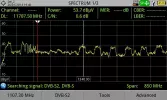
Anyone tracking the beacon? 2E shouldn't be too far from Astra 1G now
 
Astra 1E ~32E 11707V beacon peak. solly will no doubt be more accurate with his next update).

Astra 1G 31.5E now in sight (TP's to the right, 33E TP's still visible to the left - my dish has a wide acceptance angle :-rofl2 )

Won't be long now to 28E. Any latest predictions?

19:40 26/01/2014
 

Attachments

  • Astra 2E about 32E.webp
    Astra 2E about 32E.webp
    37.6 KB · Views: 55
tomorow morning
2e pass 31.5e
31e we can see if becon up
 
Last edited:
One thing to give thought too is that if some of the 33MHz TP's go spotbeam, it would yield up to 10mb of netto bitrate for operators as with bigger C/N ratios over the target UK footprint, means at 27.5k SR a FEC of 5/6 rather than 2/3 could be used. Sky certainly won't do this but other broadcasters might as, at the end of the day, they'll still be getting encryption revenue from BSkyB!
SR is not important because as SR goes down so does spectrum use.

But yes, changing FEC would increase throughput, and that's already happened. All transponders on 2F are 5/6 including the block from 12500-12750.
 
Status
Not open for further replies.
Back
Top