Astra 2E: Transit to 28.2E

Status
Not open for further replies.
The old PDFs I've got from the SES site before they where pulled show the following:

Astra 2E:
Ku-band: Europe:
64 out of 40 BSS (33 MHz)
48 FSS (26 MHz) steerable: 24 FSS (36
MHz)

Astra 2F:
Ku-band: Europe:
64 out of 28 BSS (33 MHz)
52 FSS (26 MHz) Africa: 18 FSS (36
MHz)

Astra 2G:
Ku-band: Europe:
64 out of 24 BSS (33 MHz)
52 FSS (26 Mhz) Africa: 18 FSS (36
MHz)

Interestingly the SES website claims 2F has:
Ku-band: Europe:
48; Africa: 12

So the above PDF figures could well be inaccurate.
Interesting, think I may have seen that pdf at some point a while back. It's most likely, although not guaranteed, that 2E will take the lions share of BSS TP's, 2F could accommodate a few as well as 2G although I'm sure SES have a plan to balance load across all satellites within time for backup purposes. Doesn't SES 2E claim there's 48 Ku TP's available on 2E too + 12 ME beam TP's?

Llew: I worked out 2E should be on station at 28.2E by 11am GMT Friday morning, I don't think we'll see any activity for a few days or so but may be pleasantly surprised!
 
Interesting, think I may have seen that pdf at some point a while back. It's most likely, although not guaranteed, that 2E will take the lions share of BSS TP's, 2F could accommodate a few as well as 2G although I'm sure SES have a plan to balance load across all satellites within time for backup purposes.
I agree with 2E taking most of the BSS TPs but I can't see 2G being used much for Sky euro beam channels. The official SES iPad app shows that 2G's 50cm euro beam dish limit will be within England and Wales, with Scotland and Ireland in the 60cm region. It would seem like a step backwards after the higher power of 2F and 2E across the whole of the UK and Ireland.
 
good morning to all
astra 2e near 31.6e
next few hour pass astra 1g on 31.5e
 
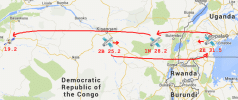
With 2B and 2E almost equidistant from 28.2E I thought I'd post this graphical representation of SES's space snooker over Africa...

space-snooker.gif
 
Hah, that's just grit on the scannerscope.
 
the satellite 2e near 31.4e
now it close old astra 1e on 31.2e
 
Should arrive early Friday morning then.

Maybe a bit later, because they have to slow it down / lower the orbit before it actually arrives. Would be interesting to know when exactly they are firing the thrusters to lower the orbit.
 
Maybe a bit later, because they have to slow it down / lower the orbit before it actually arrives. Would be interesting to know when exactly they are firing the thrusters to lower the orbit.
How quickly will it drop the 40km needed to lower in to it's GSO at 28.2E? Presumably it's all carefully calculated so the thrusters are fired and the satellite will pretty much reduce in orbit to it's required position without further east/west movement at GSO?
 
How quickly will it drop the 40km needed to lower in to it's GSO at 28.2E? Presumably it's all carefully calculated so the thrusters are fired and the satellite will pretty much reduce in orbit to it's required position without further east/west movement at GSO?

yes, they certainly calculate very well, also based on experience, because every millisecond less thruster activity saves them fuel and prolongs life expectancy. I think they start lowering the orbit a few 0.x degrees before 28.2 and it gets nearer to earth while slowing down and still moving to the west. That's why it will take longer than what we calculate now, because the average forward speed will be slower than those 0.8x degrees right now...
 
yes, they certainly calculate very well, also based on experience, because every millisecond less thruster activity saves them fuel and prolongs life expectancy. I think they start lowering the orbit a few 0.x degrees before 28.2 and it gets nearer to earth while slowing down and still moving to the west. That's why it will take longer than what we calculate now, because the average forward speed will be slower than those 0.8x degrees right now...
Interesting, thought that might be the case. So guess we can expect an extra 12hrs or so added to the expected arrival time. Perhaps if it's a clear night in Sweden Thursday and Friday night, Waveguide can do some before and after arrival photos for us.
 
Interesting, thought that might be the case. So guess we can expect an extra 12hrs or so added to the expected arrival time. Perhaps if it's a clear night in Sweden Thursday and Friday night, Waveguide can do some before and after arrival photos for us.

As a matter of interest, is it moving faster or slower than the Earth's rotational speed and what sort of difference are we looking at, assuming the Earth to be stationary?
 
before end of this weekend arrive to 28.2e
so not be worning
 
@Deso: it is currently slower than in GEO orbit. It is above geo stationary orbit, so it needs more than 24hours to complete one revolution. So it "moves" to the west. Astra 2B is under geo orbit, so to do one revolution it needs less than 24h - it moves to the east.
 
@Deso: it is currently slower than in GEO orbit. It is above geo stationary orbit, so it needs more than 24hours to complete one revolution. So it "moves" to the west. Astra 2B is under geo orbit, so to do one revolution it needs less than 24h - it moves to the east.

So it will actually speed up as it drops into Geo orbit? :unsure
 
Status
Not open for further replies.
Back
Top