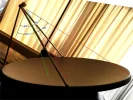
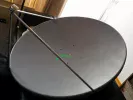
Tests of 120cm antennas

That is what I am afraid as well CH. 2 dishes, same horizontal dimension, same LNB located in focus and aiming to the proper spot.... those systems will give us same performance. In such competition is impossible to find out which dish has better metal mesh inside the plastic!
Only difference can bring us different results is- opening angle of the dish! And on my dishes #1 and #2 this angle is 79* and 89*. So, that mean that with same LNB we can get different performance of systems. But, if LNB's illumination angle is 84*, than in first case that will overiluminate dish #1 and in second case it will underiluminate dish #2. What is better- I do not know. Perhaps we should look for 2 different LNBs, one with 80* illuminating angle and another one with 90* illumination, then our systems will bring same performance again!
But, here we can continue small argument: Some are saying that CM120 is perfect antenna and producers designed it properly in such a way that LNB is pointed directly to the very center of the dish!
I am declaring that on the offset dish LNB should be pointed lower than center of dish and CM120 producers, perhaps made not perfect design.
I will be ready to apologize if I am wrong about aiming point of the LNB. But, somehow I am positive my statement is correct.
 
I am declaring that on the offset dish LNB should be pointed lower than center of dish and CM120 producers, perhaps made not perfect design.

I'm following this thread with great interest. How are you going to lower the LNB without bending the arms on the dish?
If I can squeeze a bit more out of my CM all the better.
 
This then naturally becomes more complex because it already seems that it will ultimately become a test of which lnb will work best with each dish, especially if all the dishes have different opening angles. It may well be that the Inverto Black Ultra is the best "compromise" lnb for all these dishes, performing on average better across the high, low, horizontal and vertical frequency range as opposed to another brand that might get far better results in just a specific area of the spectrum. This may well be why in certain areas, Spain for instance, people swear by "such and such" make, because it performs better in a certain part of the spectrum where weak transponders are being transmitted to their locale.

Was it common for dishes 10/15 years ago to have a varied degree of opening angles (yes I know the CM is an old dish, but they are still being produced!), I'm aware that lnbs were generally set up to operate at more specific areas of the spectrum not like the universal lnbs we more commonly use today for Ku band (on this side of the pond, at least!) Would this in some way help to see a variation in the opening range of these, predominately, older dishes? Or do we still have the same variances today between different dishes in general use? Also you have the argument for feed horns that are "matched to your dishes needs", would they perform better?

Talking about the "Aiming Point" of a dish, if we are potentially questioning that of a 120cm Channel Master dish and it proves to be "out" with a noticeable improvement with some adjustment, then that will also raise the same question regarding other makes as well? o_O
 
Having said all this, if it's a nice day tomorrow, I might unscrew the top of the lnb holder on my 120cm Channel Master, hook it up to my meter and see if I can get any improvements by tilting the lnb slightly. :D

Unfortunately, it's raining now but I did get a chance to get out and check (roughly!) where my lnb is aiming on my CM dish and it is definitely at a central position.
 
I have to say that I find it a bit strange that a specialist company would get the design of one of their products so spectacularly wrong for the focal point to be 140mm out, maybe 5 to 20mm but 140mm? That represents approximately 12% of the dish face vertical measurement! I realise that some things are not made or designed well, but this is a dish that has been made by three different companies in succession for 15 years or so, apparently Skyware Global, the current manufacturers, still use the original Andrews moulds for the SMC dish faces. I find it hard to believe that these dishes have survived being manufactured for this length of time if they have been designed so poorly.
Very well put. Must say I agree.

If I got someone to design a dish that was meant for the pro market, and indeed for Rx/Tx use, I don't think I would be happy with something that was not spot on performance-wise.
Maybe in mass-market consumer mode, where price is the key, I might scrump on the aligment etc.
But not if I were to sell this for professional use..

I think it's more likely that it's designed so that geometrical center of the dish is actually the offset center of the dish.
The indicator of this could be to check the same for 100 and 180 models.
Then it would be a general trend for the CM designer.
 
Make completely new feedarms to be able also fix multifeed issue.

:eek: Is there no way a new LNB holder could be made so you can use the feed arms you have? Less work involved?
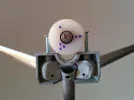
Or, hear me out....the two half spacers that take the neck of the feedhorn to 40mm. Could one half of these be cut in half. Then use one part on top of the feedhorn to push the feedhorn down, the other underneath at the back to raise it. I can't get to my dish to look if this would work, as it's wall mounted. Would it be aimed too low. Could you even bolt it up and hold it?
Now you can shoot me down :-lmao
 
Seems that this is not only about CM dishes. I just attached feedarms on Dish #2. OK there is LNB holder for 20mm neck, but diameter of the hole does not change direction of LNB. So, attached lazer device, and got spot directly in the middle of the dish, which is about 165mm too high.
 

Attachments

  • IMG_20150131_113348 (Large).webp
    IMG_20150131_113348 (Large).webp
    49.6 KB · Views: 62
  • IMG_20150131_122630 (Large).webp
    IMG_20150131_122630 (Large).webp
    30.7 KB · Views: 55
So, Parabola Calculator gives you distances from top of the dish to focal point and also distance from the bottom of the dish to focal point. So, you get triangle (remember such a figure from school times? :p ) where 3 lines are 1300mm, 721mm and 1220mm. Draw this triangle and then draw bisector line from antenna's focus. And, o sh*t, you are not getting bisector line to the middle of the dish, but somewhere lower, for example 140mm!

I am not trying to re-convince somebody if I am not sure in what I am saying. Do you?

What I am saying is that you should not consider the pysical size of the dish, but instead the physical size and position *of the working area*.
I.e. you shouldn't measure from bottom of dish, but from bottom of working area.
And on the CM120, I speculate that the bottom couple of centimeters is not part of the working area.

On the Visiosat SMC120, you clearly have a bottom parst of the dish where there are extra plastic, resulting in a flat bottom edge.
This, I am fairly certain, has been put in the design to provide mounting support for feedarms for Rx/Tx mode, providing extra strength.
(Picture borrowed from the Internet.)
 

Attachments

  • VisiosatSMCdualoptics.webp
    VisiosatSMCdualoptics.webp
    6.1 KB · Views: 45
What I am saying is that you should not consider the pysical size of the dish, but instead the physical size and position *of the working area*.
I.e. you shouldn't measure from bottom of dish, but from bottom of working area.
My dear friend st1! Why do you think that I am considering physical size of the dish?! Did I say so?
Producers do that to be able to sell their products better! Working area of CM1,2m is 1200mm x 1300mm. On the picture you can see my marks where working area starts and from those marks I do my measurements.
 

Attachments

  • IMG_20150131_125625 (Large).webp
    IMG_20150131_125625 (Large).webp
    48.7 KB · Views: 46
My dear friend st1! Why do you think that I am considering physical size of the dish?! Did I say so?
Producers do that to be able to sell their products better! Working area of CM1,2m is 1200mm x 1300mm. On the picture you can see my marks where working area starts and from those marks I do my measurements.
How do you know where the working area starts and ends without x-raying or something similar to see the metal mesh inside the plastic? Or can you detect it with a magnet or something?
 
On the gibi 125 placed a length of wood 15 cm wide on the feedarm holder just too test a theory, signal quality dropped just 1% on astra2 fta uk channels.
View attachment 72797

Regards
 
I have some kind of feeling that I am always in defense mode! :eek:
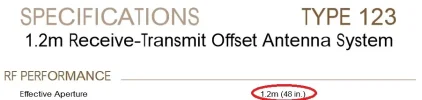
Effective aperture of CM1,2m, according to producer, and also as measured between markings I made, is 1,2M!
Dou you think that effective aperture of this dish is smaller?
 

Attachments

  • ScreenHunter_138 Jan. 31 13.23.webp
    ScreenHunter_138 Jan. 31 13.23.webp
    17.1 KB · Views: 31
Geometry (Large).webp To visualize importance of LNB's aiming I made this picture, kinda drawing (maybe not very precise and perfect). How do you think, where LNB should be pointing at? Where red line hits surface of the dish or where green one stops?
 
Last edited:
@skomedal Can you measure Gibi 125 working area? Along horizontal and vertical axis.
 
Using your dish in post 74 to outer red lines, get ~126 x 120 on the gibi not accurate as a huge snow pile hinders access.
 
On the gibi 125 placed a length of wood 15 cm wide on the feedarm holder just too test a theory, signal quality dropped just 1% on astra2 fta uk channels.Regards
That's very interesting Skomedal, I shall have to try that on my CM 120cm dish and see what difference it makes!

I have some kind of feeling that I am always in defense mode! :eek:
I wouldn't take it like that, you have put forward some very interesting points and been countered by some equally interesting points, all of which are credible. The fact of the matter is that we all would like to know what the answer is. I'm certain that we will all continue to add our bit to this with our own bits of experimentation, theory and opinion, which is the way of this forum, I most certainly will given better weather conditions than today! Equally I look forward to reading about your own findings and others as well! :D
 
I have some kind of feeling that I am always in defense mode!
Please think of the comments as from critical friends. We want to exclude, as much as possible, any sources of inaccuracy.
 
My dear friend st1! Why do you think that I am considering physical size of the dish?! Did I say so?
Producers do that to be able to sell their products better! Working area of CM1,2m is 1200mm x 1300mm. On the picture you can see my marks where working area starts and from those marks I do my measurements.
Nono, what I mean with working areas is effectively the area illuminated by the feed-horn, is we had a transmitting LNB attached to it.
This may be different from the corrugated plastic areas (as in your photo), and also different from the metal mesh/layer embedded in the dish.
It would be very intersting if we could get @Trust1 to mount his circular-laser device on the CM120, and simulate a 78* feedhorn on the reflector.
I blieve that this would show where the "ideal" working areas is according to the design of the dish.

This also leads me to think, that the feedhorn on each "standard universal" LNB may not necessarily have the same opening angle.
Therefore, som LNBs fits some dishes better than other (e.g. match the optimal working area of the dish best).
If the LNB over-illuminate the dish, it may get more signal (larger part of the dish (approaching 100%), but maybe also overspill, reflections from feed-arms etc).
Therefore, some LNBs may giver higher signal readings, but not necessarily better quality.

But then again, this may all just be speculation. I would be quite keen on speaking to the dish designer at CM - what parameters are really used??
 
Seems a gentleman called Paul Wade seems to have written an accessible yet comprehensive guide to antenna design some years ago.
From the few passages I have yet read, there seems to be some very interesting discussions of illumination patterns, feed-horn issues, signal-strength differences between center and edges of dish etc.

http://www.qsl.net/n1bwt/preface.htm

I'm still trying to digest the contents, but I came across this interesting paragraph in chapter 6 on specifically where to aim the feedhorn onto the reflector:

"Where should the feedhorn be aimed? On a conventional dish it is obvious — at the center. However, an offset feed is much closer to one edge of the dish, so that edge will be illuminated with much more energy than the opposite edge. I read an article6 which did a lengthy analysis of the various aiming strategies and concluded that small variations have little effect, so aiming at the center of the reflector is close enough."

Hmm. Now I haven't gotten to the referenced article yet, I will try and finish reading Paul Wade's book first for a better understanding.

But one things seems to shine through: It is not as simple as "getting feed to point in the right direction"...
There seems to be myriad other factors to take into account as well.
 
Back
Top