Captain Jack
Retired human
- My Satellite Setup
- See signature
- My Location
- North Somerset
Interesting. I do wonder what results Rimant's experiments will yield. Some good reading here.


When you reading all those books and see somewhere answers to questions we could not answer previously, just let us know:I will try and finish reading Paul Wade's book first for a better understanding.


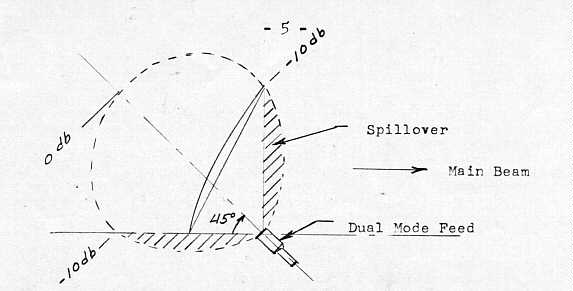

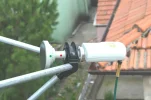

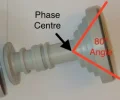
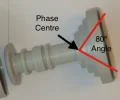
Looking at an image of a Channel Master feed horn (I don't have one!) the Scalar rings (correct term?) don't seem to project internally too much. Seeing as the dish has an opening angle of 80º I would expect the feed horn to be designed to suit? Would it not place the phase centre more likely as indicated in my image below and thereby closer to a position obtainable by a universal lnb? If not could you explain why not so that I can improve my understanding RimaAs far as I know, phase center of the feedhorn is somewhere where I put green dot. But, if we put usual universal LNB in the same holder, than it can not be reaching green dot. LNB's phase center will be located approximately where I put red dot.


 ?
?I think this is one of the reasons you get really good results with the Inverto black ultras - they have a very long neck, and the integrated feedhorn (and thuse the phase center) can be pushed very close to where the CM feedhorn has it. At that point me be placed where it is (in relation to the feed holder) to accomodate feedhorns - remember this was designed primarily as a (semi-)pro dish.Another thing which puzzles me little bit is on attached picture. Seems this is original feedhorn. As far as I know, phase center of the feedhorn is somewhere where I put green dot. But, if we put usual universal LNB in the same holder, than it can not be reaching green dot. LNB's phase center will be located approximately where I put red dot. View attachment 72843
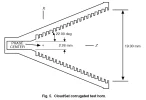
@Riverblue I doubt Phase center of feedhorn can be located where you just pointed. What would you say about this picture I screenshoted some time ago ?
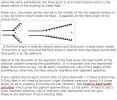

A reasonable thought.Yes, fine, but I still have some concerns.... I measured dish and calculated all the needed dimensions (used several programs) and got focal point of this dish less than 3cm from holder, where I put red dot now
I start to suspect that there are 2 different types of feedarms available for the same dish: one to be used with original feedhorn and other for universal LNB.
Yes, fine, but I still have some concerns.... I measured dish and calculated all the needed dimensions (used several programs) and got focal point of this dish less than 3cm from holder, where I put red dot now
A reasonable thought.
But after having scrutinised parts list from various incarnations of the CM manufacturer for some time now, I have never come across other single feed-arms for the dishes (100 120 180 and 240). Sure, they have other feed arms configurations, but thoser are the heavy-duty stuff for large Tx/Rx configs, yet *still* use the same feedhorn.
And I have a metal feed-holder (as opposed to the black plastic one you got) specficially made for Rx/Tx ops (e.g. Tooway TV).
This has a keyed flange support that directly matches the CM feedhorn, but uses the same 3 tubular feed-arms.
So I am fairly certain there is only one set of feed-arms available.
Rx/Tx which only fits the CM feedhorn, and that

If I knew I would certainly shoot it outis there something that we are missing regarding calculations, focal point etc of this dish? Something that is specific to the reception of a signal with an offset dish?


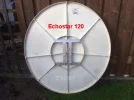
Well , not a CM but a Echostar , I will arrange the CM later this week .Nono, what I mean with working areas is effectively the area illuminated by the feed-horn, is we had a transmitting LNB attached to it.
This may be different from the corrugated plastic areas (as in your photo), and also different from the metal mesh/layer embedded in the dish.
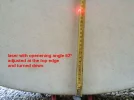
It would be very intersting if we could get @Trust1 to mount his circular-laser device on the CM120, and simulate a 78* feedhorn on the reflector.
I blieve that this would show where the "ideal" working areas is according to the design of the dish.
I would like to reiterate on this..... I think that who ever made first mold of this great dish, did not pay lots of attention to quality of their end product. Who ever replicate first design made same mistakes. So on and so on, till we get almost all antennas available on the market produced and sold with same hardware mistake. And basic mistake is - LNB is not pointed to the right spot of antenna (does not matter which program you use for calculations or just common sense). I do not believe antenna's designers intentionally moved aiming point to the center of the dish. So, yes, I am accusing them for mistake they did. I will do some tests soon and if tests show negative results I will take my word back :mad:. I think that performance of systems with CM1,2m dishes can be improved by adjusting LNB's position and direction. That's all folks.I realise that some things are not made or designed well, but this is a dish that has been made by three different companies in succession for 15 years or so, apparently Skyware Global, the current manufacturers, still use the original Andrews moulds for the SMC dish faces. I find it hard to believe that these dishes have survived being manufactured for this length of time if they have been designed so poorly.
 Maybe it is good, I will have some excuse to wife to cancel useless food-shopping day.
 I forgot to ask what plans she has .